The final part in the 3-post series about how prosciutto crudo, cured ham from Parma is made. If you’ve just stumbled on the series, the first two posts in the series covered the topics below. I’ll wait while you go read those posts and catch up.
- Making Italian Prosciutto Crudo, Cured Ham in Parma: The Salting
- Making Italian Prosciutto Crudo, Cured Ham in Parma: Drying and Sugna
Done? Ok, so we’ve put on the sugna and now these potential prosciutto di Parma are settling in for the long haul: the Maturing.
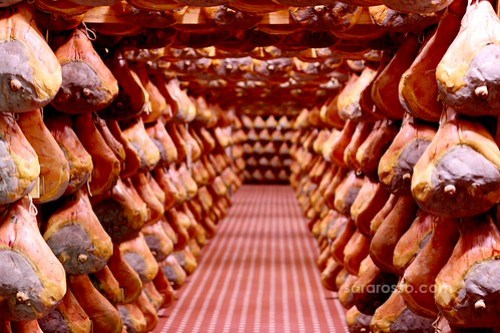
At the seventh month, after the sugna is applied, they are moved to “cantine” – cellars for 10-12 months (based on weight) for the maturing period.
That’s when you get these fascinating halls of prosciutto that I posted before:
After the maturing period, a horse bone “needle” is inserted in five points of the joint and the bone is then smelled by experts for uniformity of aroma and maturation. The needle is inserted into the area covered by the sugna and then the controller will cover up the hole made with the needle using his hands.
One of my biggest regrets is that I didn’t get a picture of the horse bone needle that is used to check the aroma and maturation of the prosciutto – I saw it sitting innocently on their table in the antechamber.

Only, and only after all passing all these previous steps will finally be fire-branded “Prosciutto di Parma” with its distinct “corona a 5 punte” – 5 pointed crown brand that you can see here, and this manufacturer’s identification:

Remember when you’re buying Prosciutto di Parma, you’re actually buying from a consortium of manufacturers in and around Parma and not just a single company. Each prosciutto leg will have a unique code that can be traced back to the individual manufacturer.

Thanks to the Prosciutto di Parma consortium there are some great videos online for the public so you can see the horse bone needle in action.
Start watching at around 4:40 to see the entire prosciutto making process I explained in these three posts, and at 6:15 to see when he sticks the horse bone into the prosciutto and smells it.
Now it’s ready to eat – pair it with your favorite parmigiano reggiano cheese, a glass of wine (a sparkling white in summer and early fall is great) and some bread and grapes and you’ll have a great meal.

and just remember where it all comes from, the pig.

I hope you enjoyed this inside look at how Prosciutto Crudo Ham from Parma is made!

That series was terrific. Your photos are stunning. Now I want to my own personal tour of the prosciutto-making place. We actually have made it here in the states with a friend, but of course, the taste is COMPLETELY different in Italy.
The tour was really great, and the proprietor definitely made it interesting – we got lucky! :) We also got a sampling of “his” prosciutto directly after the tour (not the gigantic plate you see there)
An amazing series, i have been eating crudo for so long, but surely dont know that much about it. :)
how long after the curing (and the initial drying) is the sunga applied?
Hope you can take into consideration and taste tuscany ham that is not so bad at all ;)
Still having problem trying to find the temperature at what I should hang my proscuitto of 2 months in,Its hanging downstairs under my house which is double brick with a concrete floor and quite cool but I would love to know what the recommended temperature is?
I am interested to know where i could purchase a horse bone needle in the New York area if possible .
That would be a gift to for my brother .
Thank you
My grandfather used make it. I probably should have paid attention. Great stuff.
I can’t figure out how long the legs need to dry prior to applying the Sugna
Thanks, Hart
This is indeed the greatest way taking advantage of the www: sharing something that you you know and are impressed about with unknown number of others who might be interested in the specific topic! I keep on browsing information on meat dehydration and curing and take this info as so far the best www-summary on Parma ham preparation! Thanks! … need quite soon to make an own trial … (;=